
Portable Bluetooth Speaker Gift Ideas: Outdoor Travel Essentials Waterproof | Powerful HD Sound, Dynamic Lights, 15H Playtime, BT 5.3, TWS Pairing, IPX5 Beach|Camping|Pool Accessories, Halloween Music
$19.99 (as of October 9, 2026 17:05 GMT +00:00 - More infoProduct prices and availability are accurate as of the date/time indicated and are subject to change. Any price and availability information displayed on [relevant Amazon Site(s), as applicable] at the time of purchase will apply to the purchase of this product.)Every customer who enters credit card details in your store needs reassurance that their data is safe. That reassurance comes from SSL certificates, the security technology that encrypts sensitive information and signals trustworthiness.
The good news? Shopify provides SSL certificates automatically on every plan. But understanding how SSL Shopify integration works and what it protects is critical for your store’s credibility.
This guide covers everything about SSL certificates for Shopify stores, including SSL shopify setup, Shopify SSL certificate requirements, and troubleshooting common issues.
Summary
- Shopify includes free SSL shopify certificates on all plans for automatic encryption
- SSL certificates create a secure “HTTPS” connection, encrypting data between customer and server
- The padlock icon and “Secure” badge signal trustworthiness to customers
- Custom domains, third-party apps, and checkout pages all require proper SSL shopify setup
- Regular SSL monitoring and renewal prevents security gaps and maintains customer trust
What Is an SSL Certificate?
How SSL Works
An SSL certificate is a digital credential that encrypts communication between your customer’s browser and your server. Without SSL, sensitive data like credit cards and passwords travel unencrypted, visible to anyone intercepting the connection.
With SSL, data is scrambled and unreadable to anyone but the intended recipient. The browser and server exchange encryption keys, then communicate securely.
The Visual Signal: HTTPS and the Padlock
When your site uses an SSL certificate shopify provides, the URL shows HTTPS instead of HTTP. Browsers also display a padlock icon, signaling security. This visual cue builds confidence and is now expected for all e-commerce sites. The presence of SSL shopify security is one of the first things customers look for.
Does Shopify Provide SSL Certificates?
Yes, Shopify Provides SSL Automatically
Every Shopify store, regardless of plan, gets a free SSL certificate included. The answer to “does Shopify provide SSL” is yes, Shopify manages renewal automatically, so you don’t need to maintain it yourself. Your Shopify-provided domain (yourstore.myshopify.com) comes with SSL by default. This is one of Shopify’s most valuable security features.
Custom Domains and Shopify SSL Certificate Requirements
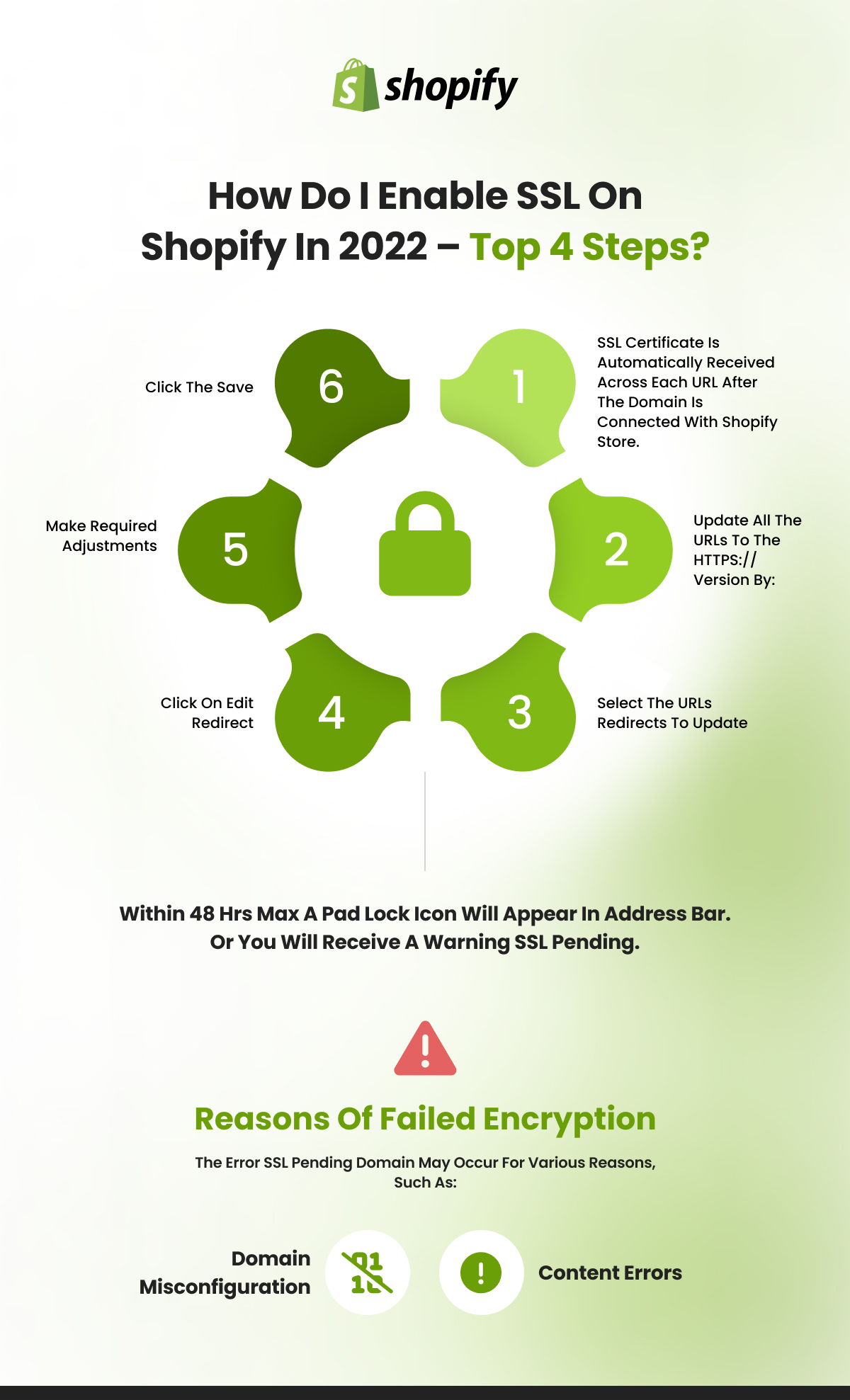
If you use a custom domain (yourstore.com), Shopify still provides an SSL certificate at no cost. Understanding Shopify SSL certificate requirements is straightforward: Once you point your domain to Shopify, the SSL is activated within 15 minutes to 48 hours. You don’t need third-party SSL providers when using Shopify.
Setting Up SSL on Your Shopify Store
For Shopify-Provided Domains
No action needed. SSL is active by default. Check your store URL, it should show HTTPS.
For Custom Domains
- Buy or transfer your domain to a registrar
- In Shopify admin, go to Settings > Domains
- Add your custom domain
- Update your domain’s DNS records as instructed by Shopify
- SSL activates automatically once DNS propagates
Checking Your SSL Status
Open your store in a browser. Look for the padlock icon next to the URL. Click it to view certificate details. If you see warnings about “not secure,” contact Shopify support immediately.

Understanding SSL Certificate Types
Single-Domain SSL
Covers one domain only (yourstore.com). Most Shopify stores use this. Subdomains aren’t covered unless explicitly included.
Wildcard SSL
Covers a primary domain and all subdomains (yourstore.com, blog.yourstore.com, help.yourstore.com). Some premium setups use these, but Shopify handles this automatically for most merchants.
Multi-Domain (SAN) SSL
Covers multiple unrelated domains under one certificate. Rarely needed for Shopify stores but available if required.
Common SSL Issues and Solutions
“SSL Not Available” Error
This usually happens when DNS records haven’t propagated or are misconfigured. If you see “SSL unavailable shopify” message, wait 24–48 hours after updating DNS, then refresh your browser cache. Contact Shopify support if it persists. This error is common when first setting up a custom domain with an SSL certificate shopify.
DNS propagation is the process where your domain registrar’s changes spread across the internet’s servers. This takes time, sometimes minutes, sometimes 48 hours. Don’t panic if your SSL shopify certificate isn’t active immediately. Keep checking every few hours and clear your browser cache between attempts.
If you see “SSL unavailable shopify” after 48 hours, verify your DNS records are correct. Log into your domain registrar (GoDaddy, Namecheap, etc.) and confirm the DNS records match what Shopify provided. A single wrong character in a DNS record breaks the entire SSL certificate shopify chain.
SSL Certificate Errors on Checkout
If your checkout page shows a security warning, your SSL shopify setup may not be fully activated. This is a critical issue with your SSL certificate shopify, resolve it immediately by contacting Shopify support.
Checkout security warnings kill sales. Customers will not enter payment info when browsers warn about insecurity. Even if the warning is a false positive or a technical glitch, it’s a conversion killer. This deserves immediate attention.
Common causes: third-party apps loading insecure content, incorrect domain configuration, or DNS misalignment. If you need help troubleshooting why your shopify SSL certificate has issues, Shopify support can diagnose this quickly.
Third-Party App SSL Issues
Some third-party apps embed content from non-HTTPS sources, triggering “mixed content” warnings. Work with the Shopify app developer to ensure all content is HTTPS-enabled.
When you install an app that adds content to your store, that content must be HTTPS. If an app loads images, JavaScript, or stylesheets from an insecure (HTTP) server, browsers flag your entire store as insecure. Even though your SSL is valid, the app’s insecure content undermines it.
Ask apps you install about their security. Reputable apps always serve content over HTTPS. If an app can’t commit to HTTPS, remove it. The SSL warning it creates isn’t worth the features it adds.
Mixed Content Warnings
If your store loads some content over HTTPS and some over HTTP, browsers flag it. This is often caused by:
- Third-party apps loading insecure content
- Custom code linking to HTTP resources
- Old CDN links that use HTTP
- Social media embeds from insecure sources
Audit your store’s page source and fix any HTTP links. Use browser developer tools (right-click > Inspect > Console) to see warnings about mixed content. Fix each one.
SSL and SEO: The Ranking Impact
Google has stated multiple times that HTTPS is a ranking factor. While it’s a relatively minor factor compared to content quality and backlinks, it matters. All else equal, HTTPS sites rank slightly higher than HTTP sites.
More importantly, HTTPS is now expected. Google Chrome marks HTTP sites as “Not Secure” in a prominent red box. Users see this and distrust the site. This doesn’t directly impact rankings, but it definitely impacts conversions.
Shopify handles this for you, all stores use HTTPS automatically. But if you’re migrating from another platform or have a complex setup with subdomains and external resources, ensure everything is HTTPS.
Certificate Transparency and Trust
Modern SSL certificates use “Certificate Transparency”, a public log of all issued certificates. This prevents fraudulent certificates from being issued without your knowledge. It also means anyone can see that you own your domain (which is good for brand safety).
You don’t need to do anything about Certificate Transparency. It’s handled automatically by Shopify and your SSL provider. But it’s good to know that your certificate is verifiable and public.
SSL Certificate Renewal and Expiration
Shopify renews your SSL certificate automatically before expiration. You don’t need to renew it manually. However, you should know:
- Certificates expire roughly every 1-2 years
- Shopify renews 30-60 days before expiration
- No downtime occurs during renewal
- Renewal is automatic and free
Check your certificate expiration date occasionally just to confirm it’s current. Click the padlock icon in your browser and view certificate details. The “Valid Until” date should be in the future.
SSL and Customer Trust
The Trust Factor
Studies show the padlock icon increases conversion rates. Customers look for that security signal before entering payment info. No HTTPS = lost sales.
Compliance Requirements
PCI DSS (the payment card industry standard) requires HTTPS encryption. Shopify’s built-in SSL ensures compliance.
Search Engine Impact
Google ranks HTTPS sites higher than HTTP. SSL is now a minor ranking factor. Make sure your site uses HTTPS everywhere.
| Component | Shopify Provides | Your Responsibility | Notes |
| SSL Certificate | Yes, free | Monitor for errors | Auto-renewed |
| Domain Registration | No | Choose registrar | Can use any registrar |
| DNS Setup | Partial | Update records | Shopify provides instructions |
| Checkout Security | Yes, always HTTPS | Verify no warnings | Critical for conversions |
Best Practices for SSL Security
Monitor Certificate Validity
SSL certificates expire. Shopify renews automatically, but verify your certificate is current. In the padlock menu, check the expiration date.
Secure All Pages, Not Just Checkout
Use HTTPS for your entire store, not just the checkout page. This protects customer data throughout their browsing experience.
Avoid Mixed Content
If your site loads some content over HTTPS and some over HTTP, browsers flag it as insecure. Use HTTPS for all resources, images, scripts, stylesheets.
Keep Apps Updated
Third-party apps must support HTTPS. Update them regularly and test for mixed content warnings after adding new apps.
Key Takeaways
- Shopify provides free SSL certificates automatically on all plans, learn more about SSL shopify features
- SSL encrypts customer data and signals security with HTTPS and a padlock icon
- Custom domains activate an SSL certificate shopify provides within 15 minutes to 48 hours of DNS setup
- SSL is critical for customer trust, PCI compliance, and search ranking
- Monitor for errors like “SSL unavailable shopify” and update DNS correctly to avoid SSL issues
Conclusion
SSL certificates are the foundation of store security. Fortunately, Shopify handles this entirely, your SSL shopify certificate is included and auto-renewed. Make sure your store displays HTTPS and the padlock icon prominently. If you see any SSL warnings or “SSL unavailable shopify” errors, resolve them immediately.
Your customers trust you with their payment information. Make sure your store’s security reflects that responsibility. Explore Shopify’s security features or contact our team to ensure your SSL shopify certificate setup is complete and your store is fully secure.
FAQ
Does Shopify automatically provide SSL certificates?
Yes, every Shopify store gets a free SSL certificate included with all plans. Shopify manages renewal automatically, so you don’t need to do anything. Understanding whether does Shopify provide SSL is simple: yes, it’s included and automatic.
How long does it take for SSL to activate on a custom domain?
SSL activates within 15 minutes to 48 hours after you update your domain’s DNS records and Shopify confirms the change. This is standard for Shopify SSL certificate activation timelines.
Can I use an SSL certificate from another provider on Shopify?
Shopify doesn’t support third-party SSL certificates. Use Shopify’s included certificate, which is free and comprehensive. The SSL certificate shopify provides is more than sufficient for all security needs.
Why does my store show “not secure” even though it’s a Shopify store?
This usually means DNS records aren’t properly configured or SSL hasn’t activated yet. Check your domain settings in Shopify admin, verify DNS records, and wait 48 hours if recently updated. If you continue seeing “SSL unavailable shopify” messages, contact support.
Is HTTPS required for all pages on my Shopify store?
Yes. All pages should use HTTPS for security and SEO. Shopify enforces this automatically for checkout pages. Your Shopify SSL certificate requirements are met automatically by the platform.
Source: https://ecommerce.folio3.com/blog/shopify-ssl-certificate/