Anker Soundcore Upgraded Bluetooth Speaker with IPX5 Waterproof, Stereo Sound, 24H Playtime, Portable Wireless Speaker for iPhone, Samsung and More (Black)
$24.99 (as of March 1, 2026 03:03 GMT +00:00 - More infoProduct prices and availability are accurate as of the date/time indicated and are subject to change. Any price and availability information displayed on [relevant Amazon Site(s), as applicable] at the time of purchase will apply to the purchase of this product.)Choosing the wrong enterprise ecommerce platform can cost you months of migration work and hundreds of thousands in rework. For high-volume merchants weighing Magento Enterprise vs Shopify Plus, the decision is rarely straightforward — both platforms target enterprise buyers, but they serve fundamentally different business models.
This guide breaks down the Shopify Plus vs Magento Enterprise comparison across pricing, customization, scalability, total cost of ownership, and migration — so you leave with a clear picture of which platform fits your operation.

Summary
- Magento Enterprise (Adobe Commerce) suits businesses with complex catalogs, custom workflows, and dedicated development resources.
- Shopify Plus is faster to launch, easier to manage, and better suited for DTC brands scaling quickly.
- The comparison between Shopify Plus vs Magento Enterprise comes down to control vs convenience.
- Total cost of ownership for Magento Enterprise is typically higher when you factor in hosting, dev, and maintenance.
- Shopify Plus vs Magento Enterprise comparison on customization strongly favors Magento — but with a steeper technical cost.
- Migration from either platform requires careful planning; switching mid-growth is expensive.
Platform Overview: What Are You Actually Comparing?
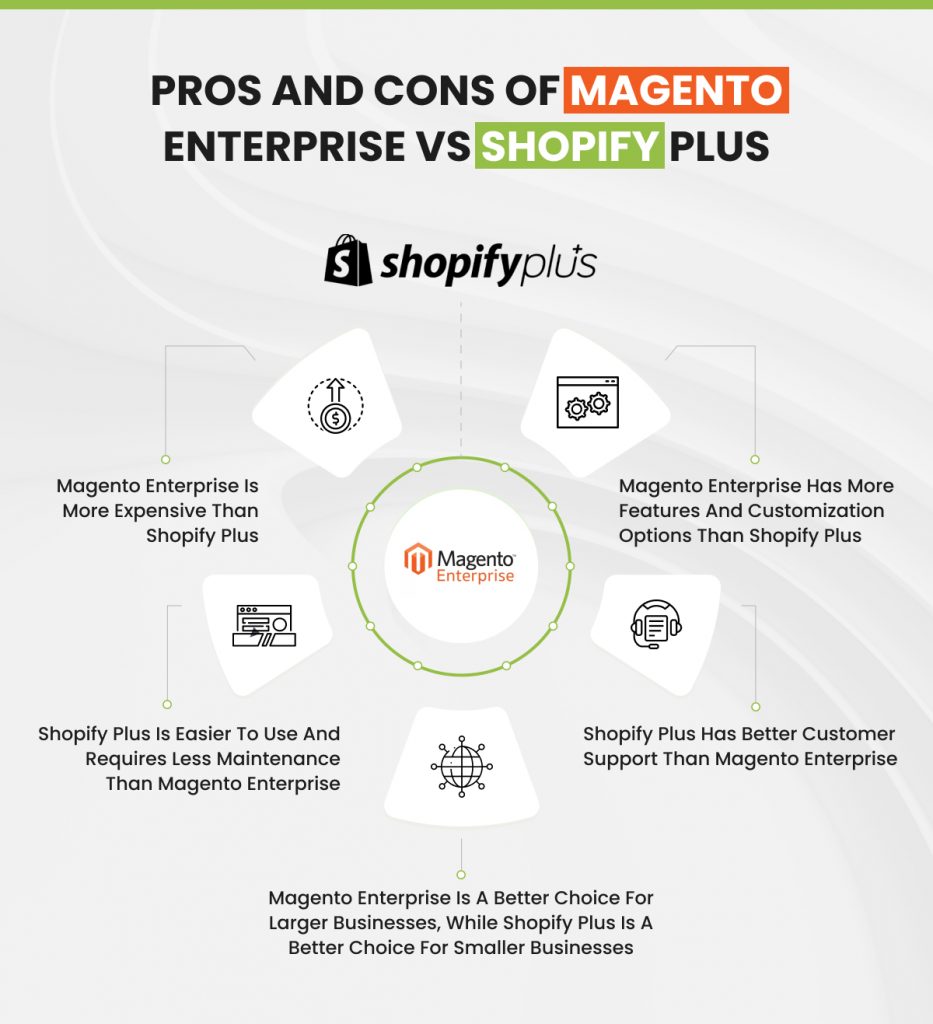
Magento Enterprise (Adobe Commerce)
Magento Enterprise — now branded Adobe Commerce — is an open-source, self-hosted platform built for large, complex ecommerce operations. Adobe acquired Magento in 2018 for $1.68 billion, signaling its commitment to enterprise buyers.
It’s the platform of choice for brands with multi-store setups, B2B portals, custom pricing rules, and deep ERP integrations. Clients like Coca-Cola, Ford, and Olympus run on Adobe Commerce.
Shopify Plus
Shopify Plus is the enterprise tier of Shopify — a fully hosted, SaaS platform. It launched to serve high-growth DTC brands that need scale without infrastructure headaches. Brands like Gymshark, Kylie Cosmetics, and Allbirds run on Shopify Plus.
Unlike Magento, Shopify Plus abstracts away hosting, security patches, and server management. You get a powerful, managed environment with limited — but growing — customization options.
Shopify Plus vs Magento Enterprise: Feature Comparison
| Feature | Magento Enterprise | Shopify Plus |
| Hosting | Self-hosted | Fully managed (SaaS) |
| Customization | Unlimited (open-source) | Limited to Liquid + APIs |
| B2B Features | Native and advanced | Available but basic |
| Multi-Store Support | Native | Via Shopify Organizations |
| App/Extension Market | 3,500+ extensions | 8,000+ apps |
| Headless Commerce | Yes | Yes (Hydrogen framework) |
| Updates & Patches | Manual | Automatic |
| Checkout Customization | Full control | Checkout Extensibility |
Shopify Plus has closed the feature gap significantly since 2022, particularly with checkout extensibility and the Hydrogen headless framework. But Magento still leads on raw customization depth, especially for B2B and complex catalog structures.

Pricing and Total Cost of Ownership
This is where the Shopify Plus and Magento Enterprise comparison gets complicated. Neither platform publishes a simple price tag.
Shopify Plus Pricing
Shopify Plus starts at approximately $2,300/month on a revenue-based model, capping around $40,000/year for most merchants. That fee includes hosting, security, CDN, and 24/7 support.
Transaction fees apply unless you use Shopify Payments, which is a meaningful consideration for merchants with complex payment stacks.
Magento Enterprise (Adobe Commerce) Pricing
Adobe Commerce licensing starts around $22,000/year for smaller enterprise accounts and scales significantly from there. But licensing is only part of the cost.
| Cost Category | Magento Enterprise | Shopify Plus |
| Platform Licensing | $22,000–$125,000+/year | $27,600–$40,000/year |
| Hosting | $5,000–$50,000/year | Included |
| Development (Initial) | $50,000–$200,000+ | $10,000–$75,000 |
| Ongoing Maintenance | $30,000–$100,000/year | Low (managed) |
| Extensions/Apps | Varies | Varies |
For most merchants doing under $50M in annual revenue, Shopify Plus delivers a significantly lower total cost of ownership. For businesses with complex technical requirements already baked into an existing Magento build, the calculus shifts.
Customization and Development Flexibility
Magento Enterprise: Full Stack Control
Magento gives developers complete access to the codebase. You can build custom modules, override core functionality, create entirely custom checkout flows, and integrate with virtually any third-party system via REST or GraphQL APIs.
This makes it the preferred choice for Magento development teams handling complex B2B portals, multi-brand architectures, or industry-specific requirements like product configurators.
The tradeoff: every customization needs to be maintained, tested, and upgraded manually. Major version upgrades (like Magento 1 to 2) have historically been full rebuilds.
Shopify Plus: Structured Flexibility
Shopify Plus offers customization within guardrails. You work within Liquid (Shopify’s templating language), Shopify Functions, and the Storefront API. For most DTC use cases, this is sufficient.
The Shopify Plus platform added checkout extensibility in 2023, which replaced the older Script Editor and opened up meaningful checkout customization without requiring full re-architecture.
Headless builds via Hydrogen (Shopify’s React-based framework) give teams more frontend flexibility while keeping Shopify’s backend commerce engine.
Scalability and Performance
Both platforms handle high-volume traffic, but in fundamentally different ways.
How Each Platform Scales
Shopify Plus scales automatically. Shopify’s infrastructure handles traffic spikes — flash sales, product drops, holiday peaks — without merchant intervention. Shopify has publicly stated its platform can handle over 10,000 transactions per minute.
Magento Enterprise scales based on your hosting configuration. With the right infrastructure (dedicated servers, Redis caching, CDN, Elasticsearch), Magento performs exceptionally. But scaling requires planning, DevOps expertise, and budget.
| Scalability Factor | Magento Enterprise | Shopify Plus |
| Traffic Spikes | Requires infrastructure planning | Automatic |
| Global CDN | Requires setup | Included |
| Page Speed (optimized) | Excellent | Excellent |
| Dev Ops Required | Yes | No |
| Multi-Region Deployment | Possible | Via Shopify Markets |
For brands with predictable traffic and strong DevOps teams, Magento’s scalability is not a limiting factor. For brands anticipating rapid, unpredictable growth, Shopify Plus removes infrastructure as a risk.
B2B Commerce: Where Magento Leads
This is one of the clearest differentiators in the Shopify Plus vs Magento Enterprise comparison. If you’re running B2B ecommerce — tiered pricing, quote workflows, net payment terms, custom catalogs per buyer — Magento Enterprise is the stronger platform out of the box.
Adobe Commerce’s B2B module includes company accounts, shared catalogs, purchase orders, requisition lists, and quote management natively. Shopify’s B2B suite, launched in 2022, has made significant progress but still requires third-party apps for many advanced workflows.
If B2B is a primary or growing channel for your business, this section of the comparison between Shopify Plus vs Magento Enterprise likely tips the decision toward Magento.
Migration Considerations – Magento Enterprise vs Shopify Plus
Moving to Shopify Plus
Migrating to Shopify Plus from Magento is one of the most common platform moves in enterprise ecommerce. The process involves migrating product data, customer records, order history, URL structures, and custom functionality.
A full Magento-to-Shopify Plus migration typically takes 3–6 months and requires a specialist agency. Key risks include SEO impact from URL changes and feature parity gaps for complex functionality.
You can read more about how to approach Shopify migration planning before committing to a timeline.
Staying on or Moving to Magento
Businesses on Magento 1 have already migrated or should have (end-of-life was June 2020). Magento 2 / Adobe Commerce continues to receive active development. Brands already on Adobe Commerce with deep customization often find the ROI of re-platforming to Shopify Plus doesn’t justify the disruption.
Which Platform Is Right for Your Business?
| Business Profile | Recommended Platform |
| DTC brand scaling fast, limited dev team | Shopify Plus |
| B2B-heavy operation with complex pricing | Magento Enterprise |
| Multi-brand, multi-region architecture | Magento Enterprise |
| Startup entering enterprise tier | Shopify Plus |
| Business needing deep ERP/CRM integration | Magento Enterprise |
| Brand prioritizing speed to market | Shopify Plus |
The right answer in the Shopify Plus vs Magento Enterprise comparison depends on your internal capabilities, catalog complexity, and growth trajectory — not just features.

Key Takeaways
- Magento Enterprise offers unmatched customization and B2B depth but carries a higher total cost of ownership and requires dedicated development resources
- Shopify Plus wins on ease of use, managed infrastructure, and speed to market — ideal for growing DTC brands
- The comparison between Shopify Plus vs Magento Enterprise on pricing favors Shopify Plus for most merchants under $50M in revenue
- B2B operations with complex workflows (tiered pricing, quote management, multi-buyer catalogs) are better served by Magento Enterprise
- Migration from either platform is a significant investment — evaluate long-term fit before committing
Frequently Asked Questions
What Is the Main Difference Between Magento Enterprise and Shopify Plus?
Magento Enterprise is a self-hosted, open-source platform offering unlimited customization but requiring dedicated development and infrastructure management. Shopify Plus is a fully managed SaaS solution that handles hosting and updates automatically, trading deep customization for simplicity and speed.
Which Platform Is Better for B2B Ecommerce: Shopify Plus or Magento Enterprise?
Magento Enterprise is stronger for B2B. It offers native features like company accounts, shared catalogs, purchase orders, and quote management. Shopify Plus has a B2B suite but requires third-party apps for advanced B2B workflows.
How Much Does Magento Enterprise Cost Compared to Shopify Plus?
Magento Enterprise licensing starts around $22,000/year, but total costs (hosting, development, maintenance) often reach $100,000–$300,000/year. Shopify Plus starts at approximately $2,300/month with hosting and support included, making the total cost of ownership lower for most merchants.
Is Shopify Plus Easier to Use Than Magento Enterprise?
Yes. Shopify Plus is designed for non-technical teams to manage day-to-day operations. Magento requires developer involvement for most backend changes, customizations, and upgrades.
Can Shopify Plus Handle Enterprise-Level Traffic?
Yes. Shopify Plus infrastructure scales automatically and has handled large flash sales and peak events without merchant-side configuration. Magento can also handle enterprise traffic but requires proactive infrastructure planning.
How Long Does It Take to Migrate From Magento to Shopify Plus?
A full Magento-to-Shopify Plus migration typically takes 3 to 6 months, depending on catalog size, custom functionality, and integration complexity. Planning for SEO continuity and feature parity should begin before the migration starts.
Conclusion
The Magento Enterprise vs Shopify Plus decision isn’t about which platform is objectively better — it’s about which one fits your team, your catalog, and your growth model. Shopify Plus wins on speed, simplicity, and predictable costs. Magento Enterprise wins on control, B2B depth, and unlimited technical flexibility.
If you’re still unsure which direction makes sense for your business, our team at Folio3 has helped hundreds of merchants evaluate, migrate, and build on both platforms. Talk to our ecommerce experts to map the right path forward.
Source: https://ecommerce.folio3.com/blog/magento-enterprise-vs-shopify-plus/