
FosPower NOAA Emergency Weather Radio A1 7400mWh Portable Power Bank, AM/FM, USB/Solar/Hand Crank Charging, Battery Operated, SOS Alarm & Flashlight for Indoor/Outdoor Emergency - Orange
$29.99 (as of March 10, 2026 04:11 GMT +00:00 - More infoProduct prices and availability are accurate as of the date/time indicated and are subject to change. Any price and availability information displayed on [relevant Amazon Site(s), as applicable] at the time of purchase will apply to the purchase of this product.)Running a growing e-commerce business means juggling multiple systems that don’t talk to each other.
Your Shopify store captures orders while NetSuite manages your backend operations, but the gap between them creates manual work, errors, and frustrated customers.
Shopify NetSuite integration solves this problem by connecting your storefront directly to your ERP system, automating data flow and eliminating the bottlenecks that slow your business down.
In this comprehensive guide, we’ll show you exactly how Shopify integration with NetSuite works, what it costs, which solutions deliver the best results, and how to implement it successfully for your business.
Summary
This guide covers everything you need to know about connecting Shopify with NetSuite:
- Integration fundamentals: How the NetSuite Shopify connector bridges your e-commerce platform with your ERP system to enable automated data synchronization
- Business benefits: Specific ways Shopify NetSuite reduces operational costs, eliminates errors, and accelerates order fulfillment
- Implementation approaches: Three distinct methods for NetSuite integration with Shopify, from point-to-point connectors to custom development
- Top integration solutions: Detailed comparison of leading Shopify to NetSuite integration providers including features, pricing, and capabilities
- Real-world applications: How businesses use Shopify integration NetSuite to manage multi-channel sales, inventory, and customer data
- Cost considerations: Complete breakdown of NetSuite Shopify integration pricing, including licensing, implementation, and ongoing maintenance
- Technical requirements: Step-by-step guidance for preparing your systems before starting the NetSuite Shopify integration process
- Common challenges: Solutions for typical obstacles businesses face when implementing Shopify NetSuite connector technology
Now that we’ve outlined what’s ahead, let’s explore why integration matters for your business.
What Is Shopify NetSuite Integration?
Shopify NetSuite integration connects your e-commerce storefront with your enterprise resource planning system to enable automated data exchange.
This integration for Shopify and NetSuite creates a seamless flow of information between both platforms.
When a customer places an order on your Shopify store, the integration automatically creates the corresponding sales order in NetSuite.
The system synchronizes inventory levels in real-time, preventing overselling situations.
Customer information updates across both platforms without manual data entry.
Financial transactions flow directly from Shopify into NetSuite’s accounting modules.
Product catalogs maintain consistency whether you manage them in Shopify or NetSuite.
The integration handles complex scenarios like partial fulfillments, refunds, and multi-warehouse operations.
This two-way data synchronization eliminates duplicate work and reduces the risk of human error.
Your teams gain a single source of truth for orders, inventory, and customer information.
Now that you understand what Shopify NetSuite integration accomplishes, let’s examine why businesses invest in this technology.
Why Businesses Need NetSuite Shopify Integration
Manual data entry between systems creates bottlenecks that limit growth.
Every order requires someone to re-enter information from Shopify into NetSuite, consuming valuable time.
This repetitive work doesn’t just waste resources—it introduces errors that damage customer relationships.
An incorrectly entered shipping address means a delayed or lost package.
Inventory discrepancies lead to overselling products you don’t have in stock.
Customers who receive “out of stock” notifications after purchase rarely return.
Without integration, your finance team spends days reconciling Shopify payments with NetSuite transactions.
This delays month-end closing and complicates tax reporting. As order volumes increase, these manual processes become impossible to sustain.
During peak seasons like Black Friday, the system breaks down completely. NetSuite Shopify connector technology eliminates these problems through automation.
Orders flow seamlessly from storefront to fulfillment without human intervention. Inventory updates happen in real-time across all sales channels.
Financial data synchronizes automatically, accelerating your close process. The integration scales effortlessly as your business grows.
Whether you process 100 orders or 10,000 orders daily, the system maintains performance.
This operational efficiency translates directly into improved customer satisfaction. Accurate inventory prevents disappointments. Faster fulfillment means happier customers.
Your team can focus on growth initiatives instead of administrative tasks.
Having established why integration matters, let’s explore the specific advantages it delivers.
Key Benefits of Shopify Integration With NetSuite
Automated Order Processing
The Shopify to NetSuite integration eliminates manual order entry completely. When customers complete purchases, orders appear instantly in NetSuite.
Your fulfillment team can begin processing immediately without waiting for data transfer. This automation reduces order processing time by up to 70%.
Faster processing means customers receive products sooner, improving satisfaction scores.
Real-Time Inventory Synchronization
Stock levels update across all sales channels simultaneously. When a product sells on Shopify, NetSuite inventory decreases automatically.
This prevents the common problem of selling items that are actually out of stock. Multi-warehouse businesses can allocate inventory intelligently based on location and availability.
The system supports all NetSuite item types, including serialized and lot-tracked products.
Improved Financial Accuracy
Sales data flows directly into your NetSuite accounting system. Revenue recognition happens automatically based on your configured rules.
The integration matches Shopify payouts with NetSuite customer payments. This automation speeds up financial close by eliminating manual reconciliation.
Your finance team gains confidence in reporting accuracy.
Enhanced Customer Experience
Customer information stays synchronized across platforms. Support teams can access the complete order history from either system.
This unified view enables faster, more informed customer service. Customers receive accurate order status updates and tracking information.
The seamless experience builds loyalty and encourages repeat purchases.
Scalability for Growth
The NetSuite Shopify integration handles increasing transaction volumes without degradation.
Peak sales periods don’t require temporary staff for data entry. You can launch new products or enter new markets without system constraints.
The integration adapts to changing business needs through customization options.
Multi-Channel Management
The integration supports omnichannel retail strategies seamlessly. Buy online, pick up in-store transactions flow through the system smoothly.
Social media sales, marketplace orders, and direct purchases all synchronize with NetSuite. This unified approach to channel management reduces complexity and errors.
With these benefits established, let’s examine how the integration actually works.
How Does Shopify Integrate With NetSuite?
The NetSuite integration with Shopify operates through automated data exchange between both systems.
A connector application sits between Shopify and NetSuite, facilitating communication.
This connector uses APIs (Application Programming Interfaces) to read and write data in both platforms.
Order Flow From Shopify to NetSuite
When a customer completes checkout on Shopify, the integration captures order details. The connector creates a corresponding sales order, cash sale, or invoice in NetSuite.
Customer information, billing address, and shipping details transfer automatically. Line items appear with correct quantities, prices, and any applied discounts.
Payment information syncs, including payment method and transaction status. The integration handles complex scenarios like split shipments and partial fulfillments.
Inventory Updates From NetSuite to Shopify
NetSuite serves as the master inventory management system for most implementations. Stock level changes in NetSuite push to Shopify within minutes.
This ensures your online store always displays accurate product availability. The integration supports multiple warehouse locations.
You can set rules for which warehouse inventory appears on which Shopify store. Advanced features include committed inventory calculations and available-to-promise logic.
Customer Data Synchronization
New customers created in Shopify appear in NetSuite’s customer database. The integration merges duplicate records to maintain data integrity.
Customer purchase history remains accessible from both systems. Updates to customer information sync bidirectionally when configured.
This ensures support teams always have current contact details.
Product and Pricing Management
You can maintain your product catalog in either Shopify or NetSuite. Changes made in the master system propagate to the connected platform.
Product descriptions, images, variants, and specifications stay synchronized. Pricing updates flow automatically based on your configuration.
The integration supports multiple price levels and customer-specific pricing.
Financial Reconciliation
Shopify payout reports import into NetSuite automatically. The system matches individual transactions with customer payments.
This automation eliminates hours of manual reconciliation work. Discrepancies are flagged for review, speeding up resolution.
Your accounting team gains complete visibility into e-commerce finances. Now that you understand the mechanics, let’s explore different implementation approaches.
Three Approaches to NetSuite Shopify Integration
Point-to-Point Connectors
Point-to-point connectors provide direct communication between Shopify and NetSuite.
These pre-built solutions reside within NetSuite’s infrastructure. Folio3’s NetSuite Shopify connector exemplifies this approach.
The connector installs directly into your NetSuite environment. Configuration happens through NetSuite’s interface, leveraging your team’s existing knowledge.
Point-to-point solutions offer the strongest security since data never touches third-party servers.
Setup typically takes 2-4 weeks for standard implementations. Costs remain predictable with fixed licensing fees.
This approach works best for businesses with straightforward integration requirements.
Middleware-Based Integration Platforms
Integration platforms like Celigo and Jitterbit provide flexible, multi-system connectivity.
These middleware solutions sit between Shopify and NetSuite. They offer visual workflow builders for designing custom data flows.
Middleware platforms excel when you need to connect multiple systems beyond just Shopify and NetSuite.
The approach provides extensive customization options. However, middleware introduces additional complexity and cost.
Data passes through the middleware platform’s servers. This creates potential security considerations for sensitive information.
Setup and configuration require specialized skills. Monthly costs increase based on transaction volumes and required features.
Choose middleware when you’re building a complex integration ecosystem.
Custom-Developed Integrations
Custom development creates a completely tailored integration solution. Your development team builds connectors specifically for your unique requirements.
This approach offers maximum flexibility but comes with high costs. Development timelines extend to months rather than weeks.
Ongoing maintenance requires dedicated technical resources. Custom integrations make sense for enterprises with highly specialized needs.
Businesses with standard e-commerce workflows rarely justify the investment. Most companies achieve better results with pre-built connector solutions. Having reviewed the approaches, let’s examine specific integration solutions.
Best Shopify NetSuite Integration Solutions
Folio3 NetSuite Shopify Connector
Folio3 specializes in NetSuite Shopify connector technology with deep NetSuite expertise. The connector installs directly within NetSuite, eliminating third-party infrastructure.
The setup includes five days of post-implementation support to ensure smooth operation. The solution handles complex scenarios like multiple warehouses and currencies.
Folio3 offers customization options for businesses with unique requirements. Pricing follows a straightforward annual or bi-annual model.
The connector supports all standard e-commerce workflows out of the box. Businesses appreciate the money-back quality guarantee.
Celigo Integration Platform
Celigo provides a comprehensive integration platform for Shopify and NetSuite. The solution offers visual workflow design tools.
Celigo handles orders, inventory, customers, and financial reconciliation. The platform includes pre-built templates that reduce implementation time.
Monthly costs scale based on transaction volumes. Celigo works well for businesses requiring multi-system integration.
The learning curve can be steep for non-technical users.
Jitterbit Harmony
Jitterbit delivers low-code integration capabilities for NetSuite integration with Shopify. The platform provides drag-and-drop interface for workflow creation.
Jitterbit supports complex data transformations and business logic. Pre-built connectors accelerate deployment.
The solution scales efficiently for high-volume operations. Pricing includes platform fees plus implementation costs.
Jitterbit fits businesses building comprehensive integration strategies.
FarApp
FarApp offers dynamic integration between Shopify and NetSuite. The platform provides customizable data mapping for each sales channel.
FarApp automates data transfer and synchronization processes. The solution emphasizes cost-effectiveness. Configuration flexibility allows for channel-specific rules.
FarApp works best for multi-channel retailers.
ChannelApe
ChannelApe connects Shopify to NetSuite with easy setup. The platform supports multiple e-commerce and marketplace integrations.
ChannelApe provides 24/7 customer support. Order orchestration capabilities help manage complex fulfillment workflows.
The solution includes inventory management across channels. Pricing scales with business size and transaction volumes. With solution options covered, let’s discuss costs.
Shopify NetSuite Integration Cost
Integration costs vary significantly based on your chosen approach and requirements.
Licensing Fees
Pre-built connectors typically charge monthly or annual subscription fees. Basic Shopify NetSuite integration solutions start around $99 per month.
Enterprise-grade connectors range from $500 to $2,000 monthly. Annual pricing often includes discounts compared to monthly billing.
Middleware platforms charge based on transaction volumes. Expect costs to increase as your order volume grows.
Implementation Costs
Point-to-point connector implementation ranges from $5,000 to $15,000. This includes configuration, testing, and initial training.
Middleware implementations cost $10,000 to $30,000 typically.
Custom development projects start at $50,000 and can exceed $200,000.
Implementation timelines directly impact costs. Longer projects require more consulting hours.
Ongoing Maintenance
Monthly maintenance costs support system updates and troubleshooting. Pre-built connectors include maintenance in subscription fees.
Custom integrations require dedicated IT resources or vendor support contracts. Budget 10-20% of the initial implementation cost annually for maintenance.
Hidden Costs to Consider
Training your team on the new integrated workflow requires time and resources.
Data cleanup before integration prevents ongoing issues. Some businesses need NetSuite customization to support integration requirements.
Factor in internal resources for project management and testing. Peak season testing may require additional investment.
Return on Investment
Most businesses achieve ROI within 12-18 months. Labor savings from eliminating manual data entry provide immediate returns.
Reducing errors decreases costs associated with customer service and returns. Faster order processing increases customer lifetime value. The investment typically pays for itself through operational efficiency gains.
Now, let’s prepare for successful implementation.
Preparing for NetSuite Shopify Integration
Assess Your Current Processes
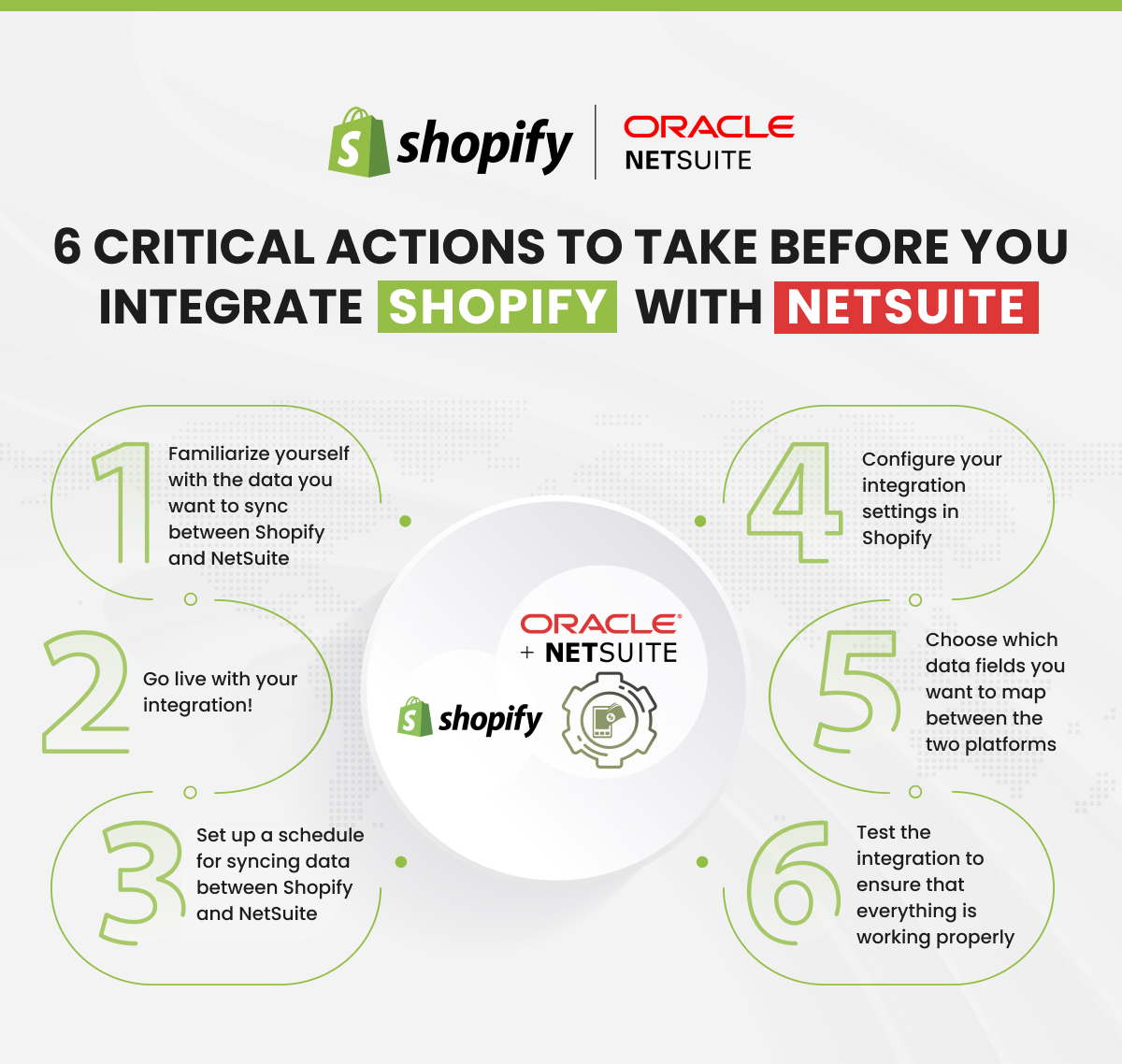
- Document how orders currently flow from Shopify to NetSuite.
- Identify specific pain points and bottlenecks in your workflow.
- Determine which data needs to be synchronized between systems.
- Understand your inventory management requirements.
- Map out customer service workflows that touch both platforms.
Clean Your Data
Data quality issues magnify after integration.
- Review and standardize customer records in both systems.
- Verify product SKUs match between Shopify and NetSuite.
- Clean up duplicate customer accounts.
- Ensure pricing information is accurate and consistent.
Define Your Requirements
- List must-have features versus nice-to-have capabilities.
- Determine whether you need multi-warehouse support.
- Identify any unique business rules for order processing.
- Decide on real-time versus scheduled synchronization.
- Clarify financial reporting requirements.
Select Your Integration Approach
- Evaluate point-to-point connectors versus middleware platforms.
- Consider your technical resources and expertise.
- Review vendor support options and response times.
- Compare the total cost of ownership across solutions.
- Request demos from multiple vendors.
Establish Success Metrics
- Define what successful integration means for your business.
- Set targets for order processing time reduction.
- Establish error rate goals.
- Determine acceptable inventory synchronization frequency.
- Plan how you’ll measure ROI.
Allocate Resources
- Assign a project manager to oversee implementation.
- Identify team members from sales, operations, and finance.
- Budget time for testing and training.
- Plan for parallel operation during transition.
- Prepare for potential disruptions during go-live.
With preparation covered, let’s address common challenges.
Common Shopify NetSuite Integration Challenges and Solutions
Data Mapping Complexity
Challenge:
Shopify and NetSuite use different data structures and field names. Products in Shopify don’t directly map to items in NetSuite.
Solution:
- Work with your integration vendor to create detailed field mappings.
- Test mappings thoroughly before go-live.
- Document any custom transformations for future reference.
Inventory Synchronization Timing
Challenge:
Delays in inventory updates can still result in overselling. Real-time synchronization may impact system performance.
Solution:
- Configure synchronization frequency based on your needs.
- High-volume sellers may need near-real-time updates.
- Lower-volume businesses can use scheduled synchronization.
- Implement buffer stock levels as a safeguard.
Payment Method Matching
Challenge:
NetSuite requires payment methods that may not exist by default. Shopify supports numerous payment gateways.
Solution:
- Create custom payment methods in NetSuite for each Shopify gateway.
- Configure the integration to map payment types correctly.
- Test each payment method individually.
Multi-Currency Transactions
Challenge:
International sales involve currency conversion and exchange rates. NetSuite and Shopify may calculate differently.
Solution:
- Enable NetSuite’s multi-currency features.
- Configure currency mappings in the integration.
- Establish clear rules for exchange rate sources.
Order Modification Handling
Challenge:
Customers may modify orders after initial submission. Changes in Shopify need to flow to NetSuite accurately.
Solution:
- Configure the integration to handle order updates.
- Implement approval workflows for significant changes.
- Train customer service teams on proper modification procedures.
Refund Processing
Challenge:
Refunds initiated in one system must synchronize with the other. Partial refunds add complexity.
Solution:
- Enable bidirectional refund synchronization.
- Configure NetSuite to automatically create credit memos.
- Establish clear policies for refund approval.
Custom Fields and Attributes
Challenge:
Your business may track data not included in standard integrations. Custom fields require special configuration.
Solution:
- Work with your vendor to map custom fields.
- Understand the limitations of your chosen integration platform.
- Consider whether customization costs justify the benefit.
Performance During Peak Seasons
Challenge:
High-volume sales periods stress integration systems. Delays during peak times damage customer experience.
Solution:
- Load test your integration before peak seasons.
- Work with your vendor to optimize for performance.
- Consider upgrading to higher-tier plans if needed.
Let’s now look at real-world applications.
Real-World Use Cases for Shopify Integration NetSuite
Multi-Channel Retail Operations
A fashion retailer sells through Shopify, Amazon, and physical stores. The Shopify NetSuite integration centralizes inventory across all channels.
When a product sells in any channel, inventory updates everywhere. This prevents overselling and maximizes sales opportunities.
The retailer can fulfill orders from any warehouse location.
B2B and B2C Combined Operations
A manufacturer sells wholesale through NetSuite and retail through Shopify. Different price levels apply based on customer type.
The integration maintains separate pricing for wholesale and retail customers. Order workflows differ between B2B and B2C transactions.
The system routes orders appropriately based on customer classification.
Subscription-Based Products
A supplement company offers monthly subscription boxes through Shopify. Recurring orders flow automatically into NetSuite.
The integration handles subscription renewals and cancellations. Inventory forecasting accounts for predictable subscription demand.
Financial reporting accurately captures recurring revenue.
Drop-Shipping Operations
An electronics retailer uses multiple suppliers for inventory. Orders route to the appropriate vendor based on product availability.
The NetSuite Shopify connector updates order status as suppliers ship. Customers receive tracking information automatically.
The retailer maintains accurate profitability reporting despite not holding inventory.
International Expansion
A U.S. retailer expands to European markets. The integration handles multiple currencies and tax rules.
Products display in local currency on region-specific Shopify stores. NetSuite consolidates financial reporting across all markets. The system complies with regional e-commerce regulations.
Key Takeaways
The Shopify NetSuite integration eliminates manual data entry and reduces operational errors by automating order, inventory, and customer information flow between your e-commerce platform and ERP system.
Point-to-point connectors like Folio3’s solution offer the most secure and cost-effective approach for businesses with standard integration needs, while middleware platforms suit organizations requiring complex multi-system connectivity.
Implementation success requires thorough data cleanup, clear requirement definition, and realistic timeline expectations—most businesses achieve ROI within 12-18 months through reduced labor costs and improved operational efficiency.
The NetSuite Shopify connector handles sophisticated scenarios, including multi-warehouse operations, international sales, and omnichannel fulfillment, making it suitable for businesses of all sizes.
Proper preparation, vendor selection, and ongoing maintenance ensure your integration continues delivering value as your business scales.
Conclusion: Transform Your E-commerce Operations With Shopify NetSuite Integration
The Shopify integration with NetSuite represents a fundamental shift from manual, error-prone processes to automated, scalable operations.
Businesses that embrace this integration gain competitive advantages through faster fulfillment, accurate inventory, and superior customer experiences.
The investment in NetSuite Shopify integration technology pays dividends through reduced operational costs and increased customer satisfaction.
Whether you choose a point-to-point connector, middleware platform, or custom development, the key lies in selecting a solution that matches your business requirements and growth trajectory.
Start by documenting your current pain points, cleaning your data, and evaluating vendors based on their expertise and support capabilities.
The right Shopify to NetSuite integration transforms your e-commerce operations from a constant challenge into a competitive advantage.
Ready to eliminate manual processes and scale your e-commerce business? Contact our integration experts to discuss how Shopify NetSuite connector technology can transform your operations.
Now, let’s address frequently asked questions.
Frequently Asked Questions
Can NetSuite Handle Multiple Payment Methods From Shopify?
NetSuite supports various payment processing options, including credit cards, ACH, and digital wallets. The Shopify integration NetSuite creates corresponding payment records for each transaction type.
You’ll need to configure payment method mappings between both systems. Each Shopify payment gateway requires a corresponding NetSuite payment method.
The integration automatically associates payments with the correct method. This ensures accurate financial reporting and reconciliation.
How Does the Folio3 Connector Integrate NetSuite With Shopify?
The Folio3 NetSuite Shopify connector operates as a point-to-point solution.
It installs directly within your NetSuite environment. The connector uses SuiteScript and Shopify APIs for data exchange.
Configuration happens through NetSuite’s native interface. This approach ensures maximum security since no third-party servers process your data.
The connector supports bidirectional synchronization of orders, inventory, customers, and financial data.
Can You Integrate Multiple Shopify Sites With NetSuite?
Yes, NetSuite can connect to multiple Shopify stores simultaneously. Each store requires a separate integration configuration.
Most connectors charge additional fees for multiple store setups. You can map each Shopify store to different NetSuite subsidiaries.
This enables separate reporting and inventory management per store. The approach works well for businesses operating multiple brands.
What Data Synchronizes With the NetSuite Integration With Shopify?
The integration typically synchronizes:
- Orders flow from Shopify to NetSuite as sales orders or invoices.
- Customer information updates bidirectionally between systems.
- Inventory levels push from NetSuite to Shopify.
- Product details including descriptions, pricing, and variants stay synchronized.
- Order fulfillment status updates from NetSuite to Shopify.
- Refunds and credit memos sync bidirectionally.
- Financial transactions including payments and payouts transfer to NetSuite.
- Shipping information updates customers through Shopify.
How Long Does Implementation Take?
Basic point-to-point connector implementations typically take 2-4 weeks. This includes configuration, testing, and training.
More complex integrations requiring customization may take 6-8 weeks. Middleware platform implementations often require 4-6 weeks.
Custom development projects extend to several months. Your data quality and preparedness significantly impact the timeline. Having clean data and clear requirements accelerates implementation.
Does the Integration Support International Operations?
Yes, most Shopify NetSuite integration solutions support multi-currency transactions.
The integration handles currency conversion based on your configuration. You can set different prices for different regions.
Tax calculation rules can vary by country or region. The system manages international shipping rules and carriers. NetSuite’s multi-subsidiary capabilities support global operations.
What Happens If the Integration Fails?
Reputable connectors include error handling and notification systems. Failed transactions queue for retry automatically.
You receive alerts when manual intervention is needed. Most platforms maintain transaction logs for troubleshooting.
Support teams can diagnose and resolve issues quickly. Having a backup process ensures business continuity during outages.
Can the Integration Be Customized?
Pre-built connectors offer configuration options within their framework. Custom field mapping accommodates unique business requirements.
Workflow modifications may require vendor assistance. Point-to-point solutions often allow more extensive customization.
Middleware platforms provide flexibility through visual workflow builders. Discuss customization needs with vendors during evaluation. Complex customizations may increase implementation costs and timeline.
Source: https://ecommerce.folio3.com/blog/shopify-to-netsuite-integration/